School Storyline Research
How do schools make what matters most recognisable?
The School Storyline Research Project explores that question across international schools worldwide.
Together, these three perspectives reveal where a school's story is coherent, where it becomes visible, and where useful questions begin.
Every school has ideas that matter deeply.
Mission and vision statements describe them. Strategic plans develop them. Classrooms, projects and conversations bring them to life.
But an interesting question sits underneath:
What actually becomes recognisable to someone encountering the school for the first time?
The School Storyline Research Project explores that question across international schools worldwide.
Rather than evaluating educational quality, inspection standards or examination outcomes, the project investigates something simpler:
What story emerges from what schools choose to make public?
Schools invest considerable time articulating their purpose. Yet the experience of reading a school's website often raises a different question:
If I spent a day here, what would I actually notice?
This research explores the relationship between intention and visibility.
Not whether a school is successful. But whether the things it values most become recognisable through its public story.
The methodology
Every school is explored through the same framework.
The framework beneath the research Designing What Matters The Six Principles: an architecture for attention, development and practice. The Storyline methodology is one practical application. Explore Designing What Matters → KnowableExaminablePossible AvailableInvestedConsequentialThree questions examine how the story is communicated.
- Explain - What does the school deliberately communicate?
- Recognise - What becomes visible through examples, stories and evidence?
- Imagine - What helps a prospective family picture themselves as part of the community?
These are considered across three dimensions of the learner experience.
- Belong - Will students feel known, safe and connected?
- Grow - Will students be challenged, supported and become more capable?
- Contribute - Will students use what they know to make a difference beyond themselves?
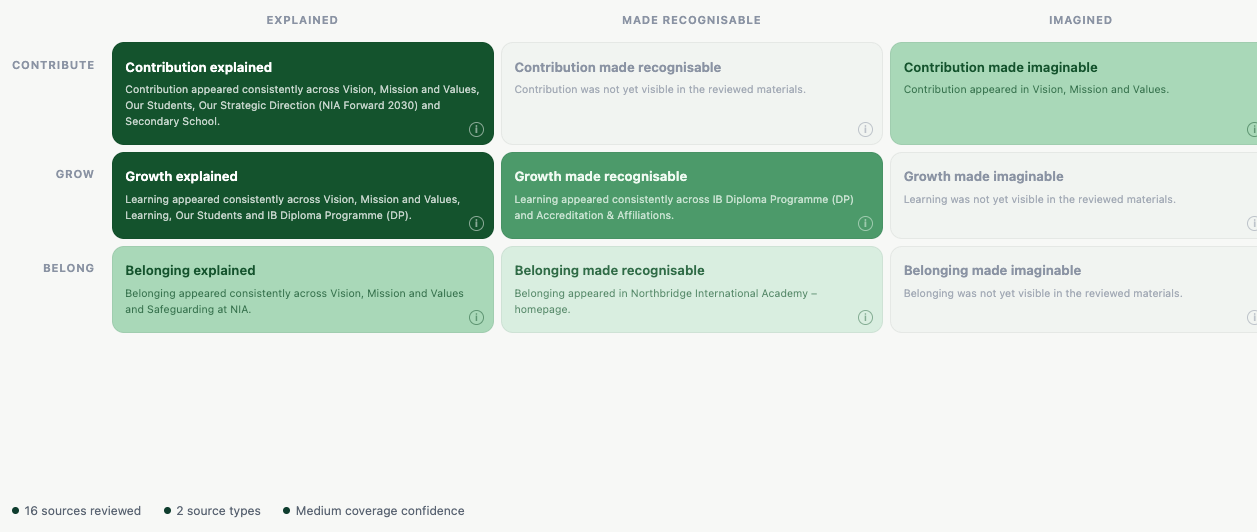
Together these form nine observation points.
The resulting Storyline Map shows where public attention becomes concentrated.
A worked example
Every school is explored in the same four movements. Here is one complete example, drawn from a fictional school created for demonstration purposes.
"We prepare our students to make tomorrow's world better."
The vision appears on the school's Purpose page, is repeated in identical text in its ten-year strategic plan, and is reworded across three further pages - five occurrences in all.
The same promise recurs across the public record:
- Our Strategic Direction page: "We prepare our students to make the world a better place"
- Secondary School page: graduates "who embody the qualities needed to make a positive impact on tomorrow's world"
- Vision of a Northbridge Graduate blockquote: "prepared to make tomorrow's world better"
- NIA Forward 2030 strategic plan (10-page PDF), linked from the homepage
Five occurrences across src_2 (Purpose page), src_7 (Strategic Direction), src_10 (Secondary), src_12 (Our Students) and src_14 (strategy PDF).
Attention concentrates in the top row. The school explains its intention clearly - and a degree of evidence makes growth recognisable - but the stories that would make belonging and contribution visible are comparatively thin.
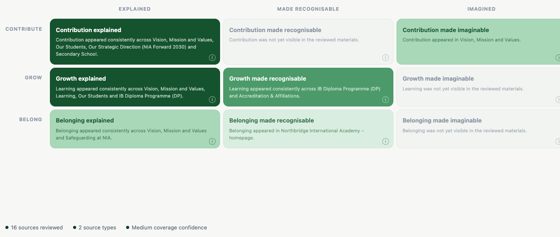
The promise is repeated five times and never once shown. What does "making tomorrow's world better" actually look like in a school week - and who decides when it has happened?
The research records curiosity rather than criticism. Where evidence is absent, the question is noted - not a judgement made.
What the research is - and isn't
The School Storyline is not:
- an inspection
- a marketing review
- a website audit
- an assessment of educational quality
It is an observational study based on publicly available evidence.
Different schools naturally tell different stories. The purpose is not to judge those differences, but to make them visible.
Public evidence
The research draws only on material made publicly available by the school. This may include:
- mission and vision
- guiding statements
- curriculum pages
- news and articles
- student stories
- strategic plans
- learning frameworks
- governance information
- admissions information
- publicly accessible reports
Each observation can be traced back to the evidence from which it emerged. Where evidence is absent, the research records curiosity rather than criticism.
From public story to school experience
A website is only one perspective.
Schools choosing to participate receive an anonymous stakeholder reflection. Leaders, teachers, students, parents, governors and operational staff answer the same nine themes from their own lived experience.
The resulting report compares:
- Public Story - what became recognisable through the school's published materials.
- School Experience - how people inside the organisation describe everyday life.
The aim is not to identify right or wrong answers, but to begin meaningful conversations.
Why this matters
Schools often ask:
Are we communicating what matters?
The School Storyline asks a slightly different question.
What matters has become recognisable?
Sometimes those answers align closely. Sometimes they reveal opportunities that no website review or inspection would ever identify. Both outcomes are valuable.
About the framework
The Storyline methodology is informed by the Designing What Matters research framework developed through Synnovate.
Rather than evaluating compliance or performance, the framework explores how organisations make important ideas visible, understandable and ultimately recognisable in practice.
The Storyline Map is one practical application of that research.
Loom
The application to governance. Policy, decisions and institutional memory in one traceable record.
Loom →Governance Instinct
The diagnostic. A structured look at how a school's governance actually operates.
Take the diagnostic →Learning Deck
The decks. Tools for teaching, leadership and whole-school learning that put the story into practice.
Explore the decks →Loom Policy Checker
A structured check of how a school's policy framework actually holds together.
Run a policy check →Participate in the research
The School Storyline research is being developed with a growing number of international schools.
Participating schools contribute two perspectives to the research:
The public story
We review the school's publicly available materials through the nine Storyline questions to explore what becomes recognisable.
The school experience
The school invites a small group of people from across its community to complete a short, anonymous nine-question reflection.
Together, these create a School Storyline: a picture of what became recognisable publicly alongside what people inside the school describe.
Participation is by request rather than automatic. This allows us to verify each school, undertake the research properly and ensure that every Storyline is based on meaningful evidence.
Participating schools receive access to their completed Storyline report.
Requests are reviewed individually and research is undertaken in batches.
Every school tells a story. The interesting question is whether it is the story the school intended people to recognise.