Many schools talk about inquiry, agency, engagement, or creativity as if the label itself explains the learning.
Frequently that's not the case.
In practice, classrooms can look busy, collaborative, and even student-centred while the thinking remains narrow, heavily directed, or prematurely closed. Students may be active without being intellectually stretched. They may be given choices without gaining real agency. Teachers may describe a lesson as inquiry-based without having deliberately designed how thinking should open, shift, deepen, and close.
This is where Synnovate Learning sits.
It is not another slogan for progressive pedagogy, and it is not a rejection of rigour, knowledge, or curriculum structure. It is a way of making the architecture of learning more visible: how thinking is directed, how it is experienced, when it shifts, and what it actually produces.
A definition of learning
Learning is the process of making connections that deepen understanding, build capability, and strengthen our ability to think, act, and adapt independently over time.
This definition matters because it moves the conversation away from activity, performance, and surface compliance - and towards something more durable.
Learning is not whether students are busy or producing something. It is whether connections are being made that hold: understanding that deepens, capability that transfers, and the ability to think independently that grows over time.
Which raises a second question: if that is what learning is, what is teaching?
High-quality teaching is the deliberate orchestration of thinking - guiding where it goes, how it is experienced, and when it shifts - so that it produces meaningful impact.
The two definitions work together. Learning is what happens in the learner. Teaching is the design and live management of the conditions that make it possible. Synnovate Learning gives teachers a shared language for both: a way of seeing what kind of learning is happening, and a way of shaping it more deliberately.
The central idea
Most schools have good intentions.
What they often lack is a clear, shared way to understand different kinds of thinking and the conditions each one requires.
Too often, classrooms and meetings mix incompatible demands:
- generate ideas, but make sure they are correct
- explore openly, but stay tightly within the expected answer
- encourage student agency, but only in low-risk ways
- ask for creativity, but evaluate too early
When this happens, thinking collapses.
Students learn to win the classroom success game rather than to navigate complex thinking. Teachers may believe they are offering inquiry or agency, but the underlying design hasn't changed.
Synnovate Learning is built around a simple but demanding principle:
Different types of thinking require different conditions.
Learning inside an operating system
Learning does not happen in a vacuum. Beneath every lesson is a hidden operating system: where attention goes, how effort is interpreted, what learners feel permitted to try, and how meaning is constructed.
Synnovate Learning applies that wider perspective to classroom practice. It helps teachers and leaders see not just what is being taught, but what kind of thinking is being shaped.
The classroom is not separate from leadership, governance or culture. It is one place where the same movement becomes visible.
Read the wider Synnovate Perspective.The Learning Diagnostic
At the centre is a simple 2×2 diagnostic grid for reading the kind of thinking a task is asking for.
Locate where thinking is. Then follow where it moves.
The grid helps make visible the different conditions of thinking by holding two tensions together:
- Open ↔ Closed thinking
- Emergent ↔ Structured experience
Open Thinking
Thinking expands. Possibilities increase.
- Multiple ideas, interpretations, or directions are encouraged
- Judgement is delayed or suspended
- The goal is to generate, notice, explore, or question
In practice
- "What do you notice?"
- "What could this mean?"
- "What are all the possible ways…?"
Common mistake
Saying thinking is open while subtly steering toward a single "correct" answer.
Closed Thinking
Thinking narrows. Precision increases.
- Ideas are evaluated, selected, or refined
- Criteria are applied
- The goal is to clarify, conclude, test, or decide
In practice
- "Which answer is correct - and why?"
- "Which option is strongest?"
- "What do we commit to?"
Common mistake
Closing too early before enough exploration has occurred.
Emergent Thinking
Thinking is not fully predetermined. It unfolds through interaction.
- Direction develops as ideas are explored
- Outcomes are not fixed in advance
- The goal is to discover patterns, surface insights, or allow ideas to take shape
In practice
- Students or participants influence the direction
- Unexpected ideas are pursued
- The path is responsive, not fixed
Common mistake
Confusing emergent with unstructured or aimless.
Structured Thinking
Thinking is intentionally guided by constraints.
- The path, focus, or method is planned
- Attention is directed toward specific goals
- The goal is to channel effort, build coherence, or ensure progress
In practice
- Clear steps, scaffolds, or models
- Specific questions or tasks
- Defined success criteria
Common mistake
Over-structuring to the point where thinking cannot open.
The grid is not the whole diagnostic. It is the shared reference point.
It allows teachers, leaders, and facilitators to ask:
- Where is thinking right now?
- Where does it need to go next?
- What kind of experience matches this position?
- Are we opening too early, closing too quickly, or failing to shift at all?
This creates a language for diagnosing learning and planning movement with more precision.
Four interlocking elements
The diagnostic works through four simultaneous elements. They should not be collapsed into one another.
Element 01 - Framing
Thinking trajectory
Where is thinking going?
This is the framing layer. It defines the journey across the grid.
A lesson, unit, workshop, or meeting may begin by opening up possibilities, move into guided exploration, shift into synthesis, and eventually close around precision, application, or decision.
The key question is not just what are people doing? but what is the intended movement in thinking?
Without trajectory, activity can become busy but intellectually static.
Element 02 - Design
Thinking conditions
What does it feel like to think here?
This is the design layer. Each position on the grid requires different conditions.
For example:
- Open + Emergent may require generative design, low judgement, broad noticing, speculative thinking
- Open + Structured may require guided inquiry, scaffolded investigation, deliberate comparison
- Closed + Emergent may require synthesis, meaning-making, explanation, pattern-building
- Closed + Structured may require precision, evaluation, application, decision, refinement
Design is not just a set of activities. It is the creation of conditions that fit the thinking required.
Element 03 - Live regulation
Thinking control: the 4D cycle
What kind of thinking is allowed right now?
This is the live regulation layer - a four-phase cycle that a teacher, chair, or facilitator can shift between in real time.
A cycle, not a sequence. Facilitators shift between phases as the thinking requires.
Poor sessions are rarely short of activity. They are short of deliberate movement between phases. Judgement closes down before exploration has opened enough. Development stalls because no disruption preceded it. Decisions land without the friction that makes them stick. The 4D cycle names where thinking is, so the facilitator can choose where to take it next.
The 4D cycle builds on familiar models of creative and strategic thinking - the movement between expanding and narrowing ideas, often described as divergent and convergent thinking or the "double diamond."
What those models describe well is the overall shape of thinking. What they leave implicit is how that movement is controlled in the moment.
The 4D cycle makes those control points explicit.
- Disrupt introduces the friction needed to break existing assumptions
- Diverge expands the space of possible ideas
- Develop shapes and strengthens emerging thinking
- Decide brings clarity, commitment, and direction
The shift is small but important.
Instead of describing thinking after the fact, the 4D cycle gives facilitators a way to regulate it as it happens.
The 4D cycle doesn't tell you what to think. It tells you what kind of thinking is needed next.
Element 04 - Assurance
Thinking impact
Is this actually producing meaningful learning?
SPARK is not a checklist. It is a way of reading the impact that thinking is producing.
Each element answers: What is changing as a result of this thinking?
Impact is not a checklist. It rises and falls across all five dimensions at once.
How to use SPARK in the diagnostic
SPARK does not apply equally at all times. Different phases of thinking produce different signals.
The question is not: "Is everything present?"
But: "What kind of impact is this phase meant to produce - and is it happening?"
What is this thinking changing?
SPARK does not define learning. It reveals whether thinking is making a difference.
Agency, reconsidered
One of the most overused words in education is agency.
It is often reduced to superficial choice: choose a task, choose a question, choose a format.
That is not necessarily agency.
Within this diagnostic, agency means something more demanding:
Agency is the capacity to recognise, select, and regulate appropriate modes of thinking in response to a task.
In other words, learners become increasingly able to judge:
- when to explore and when to narrow
- when to generate and when to evaluate
- when to challenge assumptions and when to refine
- when they are ready to decide and when they are not
This shifts agency away from lifestyle pedagogy and back toward intellectual self-regulation.
Students do not begin here automatically. Early on, the teacher or facilitator carries more of the control. Over time, learners should increasingly internalise these moves for themselves.
That is one of the second-order consequences of high-quality learning design: the gradual transfer of control from teacher to learner.
Impact
Impact is often spoken about loosely, as if it were self-evident.
Within Synnovate Learning, impact is not just what students produce in the moment. It is the sustained improvement in how learners build knowledge, deepen understanding, apply what they know, and increasingly regulate their own thinking.
This is why the diagnostic matters.
It is not simply trying to make lessons more engaging or more creative. It is trying to make visible the conditions under which learning becomes durable, transferable, and self-directing.
That means impact can be understood not only through output, but through change over time:
- stronger conceptual understanding
- more precise and flexible application
- better judgement about how to approach unfamiliar tasks
- more independent regulation of thinking
- more coherent learning experiences across classrooms and phases
Why this matters in schools
Many schools claim to use inquiry-based learning, concept-based learning, student agency, or international-minded pedagogy. In many cases, the aspiration is real, but the design remains inconsistent.
The result is a kind of conceptual fog:
- strong rhetoric, weak coherence
- isolated good lessons, weak shared language
- activity-rich classrooms, uneven intellectual design
- "inquiry" used as a label rather than a disciplined approach to thinking
Synnovate Learning aims to address that gap.
It doesn't ask schools to abandon content, curriculum, direct instruction, or rigour. Nor does it insist that all learning be open-ended.
Instead, it asks a more precise question:
What kind of thinking is needed here, and have we deliberately designed the conditions to support it?
This is as relevant to a content-heavy lesson as it is to an IB inquiry unit. It is as relevant to a strategy meeting as it is to a classroom.
A coherent model, not competing frameworks
The strength of this approach is that it brings together several ideas that often remain disconnected:
- a way to frame movement in learning
- a way to design conditions matched to that movement
- a way to regulate creativity and judgement in real time
- a way to assure that learning remains deep and impactful
Rather than offering another isolated framework, it provides a coherent architecture for making sense of high-quality learning.
How this connects to the wider Synnovate system
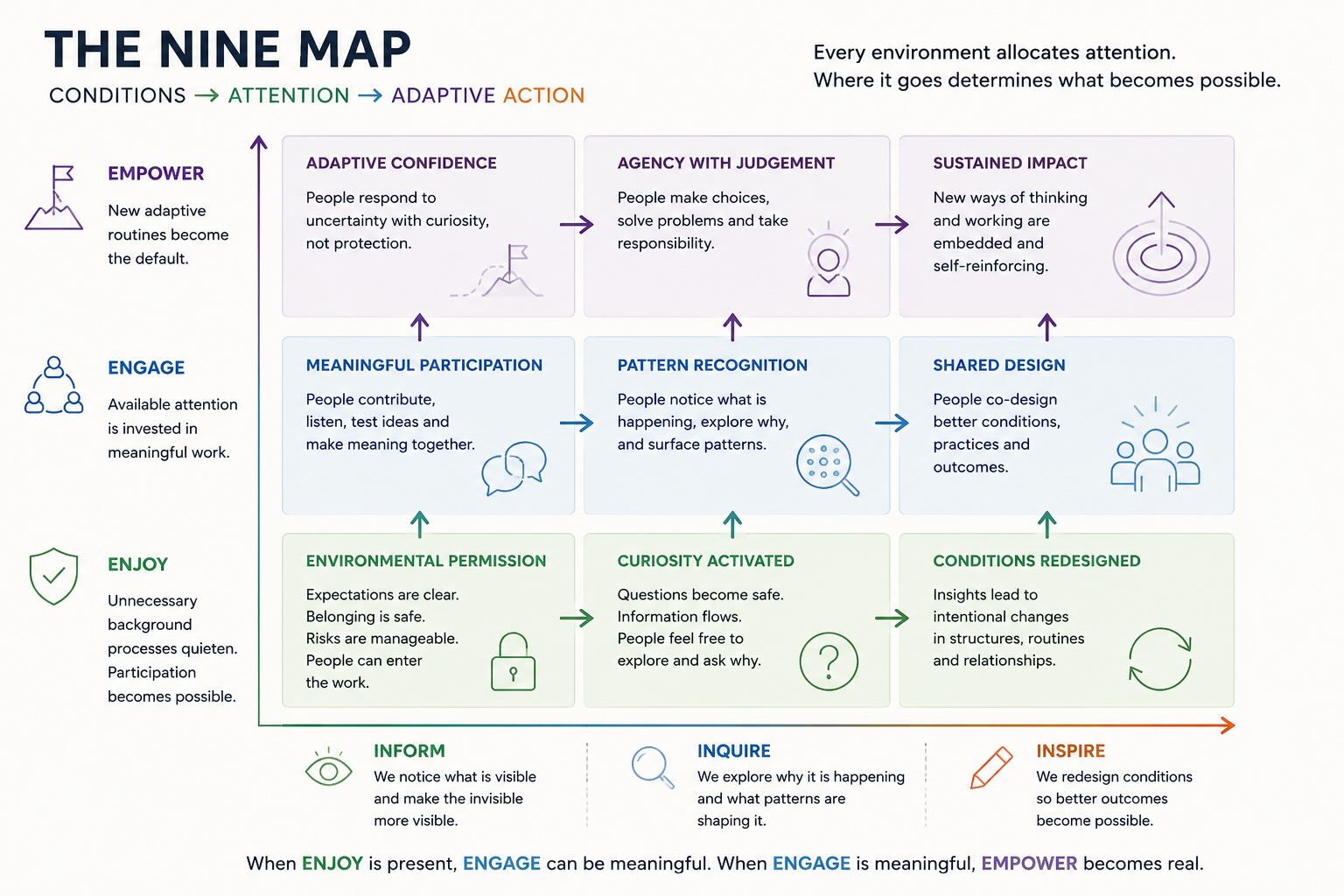
Every Synnovate framework sits inside the same wider movement: Inform, Inquire, Inspire; Enjoy, Engage, Empower.
Synnovate Learning is the classroom expression of that movement. It asks how learning conditions make participation possible, how attention becomes invested, and how better routines of thinking become stable over time.
Closing thought
High-quality learning is not simply a matter of good intentions, engaging tasks, or impressive products.
It depends on whether thinking has been deliberately shaped over time - so that learners not only know more, but understand more deeply, apply more intelligently, and increasingly take control of how they learn.
That is the work.